Stone Surrounds for Older Houses: A Buyer's Guide to Period Fireplaces
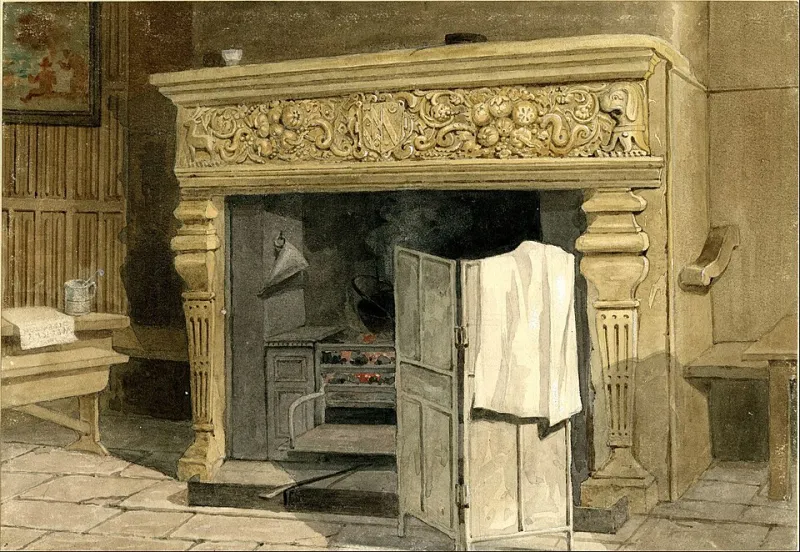
Photo: John Wykeham Archer (1808-1864), Public domain, via Wikimedia Commons
A stone fireplace surround is one of the few architectural features that can anchor a room without overwhelming it. In older UK houses, however, the buying process is rarely straightforward. Victorian terraces, Edwardian villas and rural cottages were built to different proportions and with different expectations of heat and chimney performance. A surround that looks appropriate in a photograph may be the wrong scale, the wrong material or the wrong period for the room. A measured approach is more valuable than a rapid purchase.
Start with the room and the house, not the surround
The first question is not which stone to choose, but what the room originally required. In a Victorian front parlour, a cast-iron insert with slate slips and a marble or limestone surround was a common arrangement. The detailing tended to be confident but controlled. In an Edwardian house, openings and room proportions may be slightly wider, and surrounds often became simpler or more classical in outline. In a cottage, a grand carved surround can sit awkwardly against low ceilings, uneven walls and a more utilitarian chimney arrangement.
The useful discipline is to look at neighbouring houses of similar date, examine any surviving original features and consider the room's role. A formal front room can carry more detail than a modest dining room or bedroom. A cottage interior often benefits from restraint and from materials that look as though they belong to the building rather than to a showroom.
Material choices: limestone, sandstone, marble and slate
Limestone is a natural choice for many period interiors. It is relatively easy to carve, warm in colour and widely used in architectural detailing. It is also porous, so it benefits from sensible care and a suitable finish. Sandstone varies considerably by region and can be an excellent match for older houses, particularly where local stone is part of the building's identity. Its colour and hardness differ from quarry to quarry, so samples matter.
Marble brings formality and visual movement. It can be very effective in a Victorian or Edwardian parlour, but it is softer than granite and sensitive to acids, so it should be specified with an appropriate finish and maintained accordingly. Slate is practical, dark and well suited to simpler surrounds and slips. It can be a good choice where a quiet, architectural appearance is wanted rather than a highly decorative focal point.
Matching original detailing without pastiche
The aim is continuity, not imitation for its own sake. Original detailing can often be inferred from surviving mouldings, the chimney breast, neighbouring properties or old photographs. If the original surround is missing, a simple design based on the house's period is usually more convincing than an elaborate composition that tries too hard to look old.
Pastiche often appears in the proportions. A surround may have the right motifs but the wrong scale, or a heavy mantel may sit beneath a delicate cornice. Buying from a salvage yard can be rewarding, but provenance and condition should be checked carefully. Reproduction surrounds can also be appropriate, provided the stone, dimensions and detailing are specified honestly rather than presented as something they are not.
Measure the opening before you fall in love
The fireplace opening is the critical dimension. Width, height and depth must be checked alongside the chimney breast, lintel and flue arrangement. A cast-iron insert or stove has its own requirements, and the surround must accommodate them without compromising clearances. The leg width and mantel depth also affect how the surround sits in the room.
In older properties, openings are often out of square and hearths may have been altered. A site survey is therefore more reliable than a showroom measurement alone. Where solid fuel or gas appliances are involved, installation should follow the relevant regulations and manufacturer instructions, and a competent installer should confirm the arrangement before purchase.
Hearths, back panels and slips
The hearth is not a decorative afterthought. It provides a non-combustible base and must be correctly sized and constructed for the appliance and the room. The back panel and slips complete the composition and protect the surrounding fabric. Stone, slate and other non-combustible materials are commonly used, but the specification should suit the fire being installed rather than simply the visual scheme.
This is also where cheap purchases often reveal their limitations. A surround without a coherent hearth and back panel may require costly adaptation. It is better to plan the whole assembly, including the floor level and any ventilation requirements, before committing to the stone.
Buying online and from salvage yards
Online buying can work well when the seller provides clear dimensions, detailed photographs and an honest account of repairs, cracks and soot staining. Ask about the return policy and whether the item can be collected safely. Salvage yards reward patience. Check for structural cracks, previous repairs, missing sections and evidence of heat damage. A worn surface is not necessarily a problem; a fractured lintel or a badly repaired leg may be.
For listed buildings and properties in conservation areas, consent may be required before altering a fireplace or chimney breast. Homeowners should check with the local authority before proceeding, particularly where original fabric would be removed.
A measured purchase
The most successful stone fireplace projects begin with the house, not the catalogue. Establish the period, measure the opening, plan the hearth and back panel, and choose a material that suits both the room and the way it will be used. A restrained surround that fits the architecture will usually age better than a grand gesture that fights it.