Block, Batch and Book-Match: Reserving Natural Stone Before the Worktop Is Cut
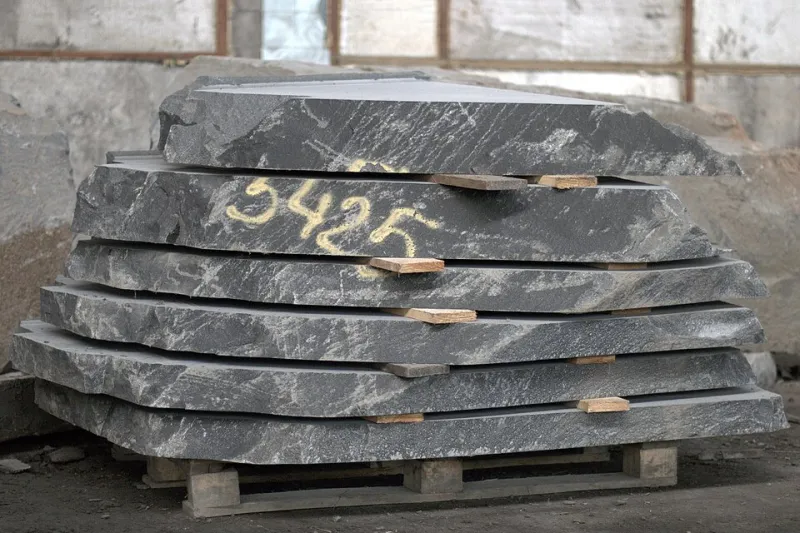
Photo: Aleksandr Przhelkovskiy, CC BY-SA 4.0, via Wikimedia Commons
Natural stone is a product of geology, not a manufactured colour. Two slabs cut from the same block can differ; slabs from different blocks can differ more. The sample in a showroom may be beautiful, but it is not a contract for the slab that will arrive. For UK buyers, the safeguard is to reserve the actual stone, inspect it, and plan the cuts before fabrication begins.
Why a sample is not a promise
Samples are often small offcuts selected for colour and figure. They may be polished, sealed or photographed under warm showroom lighting. A full slab under natural daylight can look cooler, darker or more heavily veined. Some stones are sold as a batch or bundle, and the yard may hold several bundles of the same name. If you fall in love with a display panel, ask whether the panel is the actual slab, a representative sample or a photograph. The answer changes what you are buying.
Batch, block and bundle: what the terms mean
Blocks are extracted from the quarry; slabs are sawn from a block; bundles are groups of slabs cut in sequence. A batch may refer to a production run or a group of bundles. Book-matching is the practice of opening consecutive slabs like a book so that veins mirror across a seam.
For a worktop, the most important questions are whether the slabs are from the same block, whether they are consecutive, and whether the fabricator can lay out the job to keep the figure continuous. For floors, batch variation is often more visible because tiles are seen side by side. For splashbacks, a mismatch can be glaring because the stone is at eye level.
Before paying a deposit: questions for the supplier
Ask to see the actual slabs, not just a sample. Request photographs with a scale and the slab numbers visible. Ask whether the price is for a specific bundle or for similar material. Confirm the finish, thickness and edge profile in writing. Ask what happens if the reserved slabs are damaged before fabrication. Ask whether the deposit is refundable and what lead time applies. If you cannot visit the yard, ask for a video walk-through in daylight and a written description of the variation. A reputable supplier will expect these questions.
A practical reservation sequence
First, settle the material, finish and thickness. Second, visit the yard and inspect the slabs in daylight, wet and dry if possible. Third, reserve specific slabs in writing, quoting the slab or bundle numbers. Fourth, agree a cutting plan with the fabricator before the slabs leave the yard. Fifth, template only after the cabinets are installed and the slabs are on reserve. Sixth, inspect the slabs again before fabrication. Seventh, keep the offcuts or order a spare slab. This sequence is more important than the brand name on the sample.
Planning cuts around variation
Variation is easier to manage when the layout is designed around it. Put the most consistent slabs on the main run and use the more figured slabs on an island or a feature upstand. Keep book-matched pairs together at a seam, and avoid placing a seam where two strongly veined slabs meet at an awkward angle.
For floors, blend tiles from several crates rather than laying one crate at a time. For splashbacks, cut them from the same slab as the worktop where possible. If the stone has a directional figure, agree the orientation before cutting. The fabricator should produce a slab layout drawing showing each cut, seam and offcut.
Order sensible spares
Natural stone is difficult to match later. A small repair or a future extension may need material from the same batch. For worktops, keep the offcuts from sink and hob cut-outs; they can be used for upstands, shelves or repairs. For floors, order a spare box or two, or at least 10 per cent extra, and store it flat and dry. For a large project, a spare slab may be worth the cost. Label the spares with the slab numbers and keep them with the project file.
The slab you saw can be the slab you get, but only if you reserve it, inspect it and plan around its variation. In a natural material, difference is not a defect; it is the character of the stone. The practical task is to make that character predictable before the first cut.