Hallways That Take a Beating: Choosing Natural Stone Flooring for UK Entrances and Boot Rooms
Natural stone in a hallway is not a decorative afterthought. It is the surface that mediates between the outside world and the rest of the house, and in a boot room or utility it takes the full load: wet paws, grit from the lane, garden soil, road salt from January to March. Specifying it well is largely a matter of anticipating that load before the first tile is fixed, because very little of what follows can be corrected later without lifting the floor.
The four stones most often considered for these spaces — limestone, slate, sandstone and marble — behave very differently under pressure. None of them is unsuitable in every circumstance; each of them is unsuitable in some. What follows is an attempt to say which, and why.
Slip resistance should be a number, not an impression
Slip resistance is usually discussed in terms of finishes rather than measurements, which is unhelpful when a floor is being signed off. The UK pendulum test, standardised in BS 7976, produces a Pendulum Test Value (PTV), and for an entrance that will be walked on in wet shoes a wet value in the high thirties or above is a sensible target. The R-ratings borrowed from German practice are also quoted; a polished surface typically sits near R9, while flamed or brushed stones reach R11 and beyond.
The practical consequence is that the finish matters more than the stone. Honed limestone and honed marble are both slippery when wet; flamed sandstone and riven slate generally are not. In a boot room the question is not simply which surface is safest, but which finish will still look acceptable after two winters, since a high-grip texture that traps mud and cannot be scrubbed clean is not a success either.
Limestone
Limestone is the default choice across much of southern England, and for good reason. Compact, fine-grained beds take a honed or lightly brushed finish, wear evenly, and sit comfortably in older houses. It is, however, calcareous: acids will etch it, including wine, vinegar and several household cleaners, and bleach-based products used in a utility are best kept away from it. Absorption varies widely between beds, so a dense limestone may need little more than an impregnating sealer, while an open, fossil-rich stone will want more attention. Where limestone is chosen for a boot room, a honed or brushed surface on a denser bed is the safer specification, with re-sealing anticipated every couple of years.
Slate
Slate is the most forgiving of the four in a working entrance. It is dense and of low porosity, so it tolerates standing water and frequent wet cleaning, and it is unaffected by the acids that trouble limestone. Riven, cleft surfaces are naturally slip-resistant but uneven enough to catch a boot heel and to hold grit in their valleys; a brushed or honed slate gives most of the grip with far less to trap. Welsh slate and the harder Spanish and Brazilian slates sold in the UK differ in hardness and in thickness tolerance, and that tolerance matters when a floor has to meet a doorstep cleanly.
Sandstone
Sandstone, including the Yorkstone traditionally used for thresholds and flags, is among the least slippery of the group when left with a textured finish, and the most accommodating of period-appropriate laying. It is also softer and more absorbent than slate, stains from oil and rust are difficult to lift, and it rewards a penetrating sealer and a degree of philosophical acceptance. It is the material most likely to look right in an old farmhouse and most likely to disappoint a household expecting showroom uniformity.
Marble
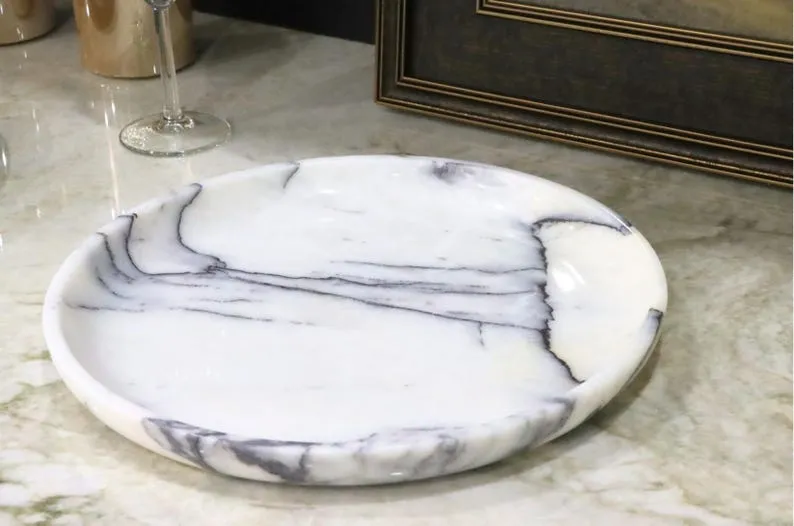
Marble appears in halls occasionally and in boot rooms very rarely, for good reason. It is as soft as limestone and the most acid-sensitive of the four. A polished marble in an entrance will dull along the main line of traffic within a few years; a honed or tumbled marble will hold its appearance better, but still needs a mat strategy and a forgiving household. Where marble is wanted for its appearance, it is better used in the inner hall than at the door that everyone actually uses.
Underfloor heating: a good partner, if the build-up is right
Stone conducts heat well and makes an excellent partner for underfloor heating, but only when the construction has been designed for it. Two points matter. The stone should be thick enough not to crack under point loads and thin enough not to blunt the output; 10–12mm is the usual domestic range. And the heating should be commissioned gradually, with the floor brought up to temperature over several days once the adhesive has cured. In older houses without insulation beneath, much of the heat will travel downwards, and an assessment of the build-up is worth more than reassurance from a tile showroom.
Sealing, grit and the traffic line
Two families of sealer are sold for stone floors, and they do different jobs. Impregnating sealers sit within the pores and slow absorption without forming a film; they leave the surface looking like stone and suit limestone, sandstone and most slate. Topical sealers form a coating that wears through along the traffic line and then looks worse than no sealer at all. In a hallway, an impregnator plus a well-placed doormat will usually outperform anything applied to the floor itself. Grit is abrasive and will dull any finish eventually; the cheapest protection is a coarse external mat, a secondary internal mat, and a no-shoes convention that visitors will politely ignore.
Period houses and the breathability question
In an older property the question is often not which new stone to buy but whether to keep the flags already there. Original quarry tiles and slate flags in a hall without a damp-proof course rely on breathing; sealing them with a film-forming product can trap moisture and draw salts to the surface. Where old flags are retained, a breathable impregnator and lime-compatible bedding are the orthodox approach, with a close eye kept on any damp. New stone can be laid sympathetically, but the depth of the floor build-up, the presence of a DPC and the levels at the thresholds all need settling first.
What to agree before the first tile is laid
- Confirm the wet slip performance of the actual finish being supplied, not of the stone type in general.
- Ask for the thickness tolerance of the consignment; flagstone thickness varies more than showroom samples suggest.
- Check substrate deflection and the position of movement joints.
- Confirm compatibility with underfloor heating, including the adhesive and the commissioning schedule.
- Order ten per cent extra from the same batch for cuts and future repairs.
- Agree the sealing and maintenance regime, and the products, before handover.
- Test a sample with wet grit and a muddy boot, then decide.
Living with the decision
A stone entrance floor is a long commitment, and the households that are happiest with theirs are usually the ones that chose the finish around the way the door is actually used rather than around a photograph. Slate and textured sandstone forgive the most. Limestone rewards care. Marble rewards a household that enters through another door.