Frost Line and Footfall: Choosing Stone That Belongs Outside a British Home

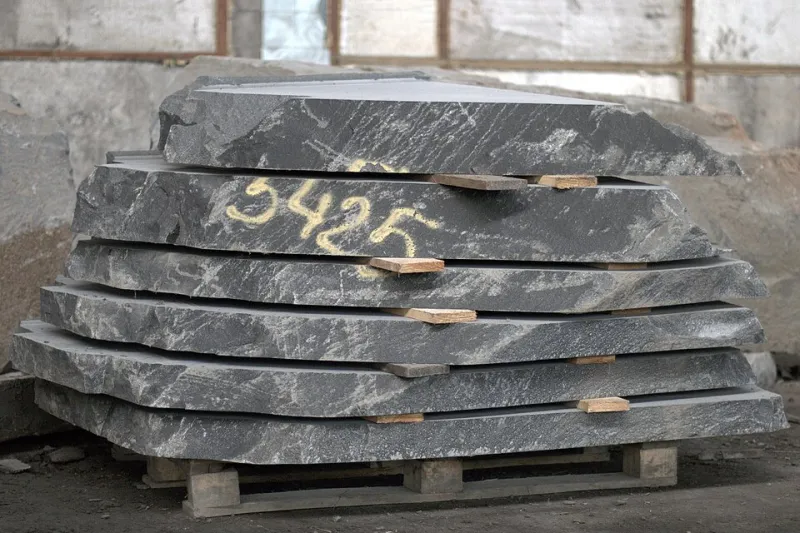
Photo: Katja Hottingen, CC BY-SA 4.0, via Wikimedia Commons
A stone that performs immaculately in a kitchen can fail within two winters of leaving the back door. The reasons are rarely dramatic. Water enters a pore structure, the temperature drops, ice expands, and a surface that looked flawless on the sample board begins to shell, spall or lose its grip underfoot. For UK homeowners planning steps, patio edges, copings or a modest outdoor kitchen, the specification decisions taken before the first slab is laid matter far more than any sealer applied afterwards.
Why an indoor favourite rarely survives outside
Most interior stone is chosen for appearance and workability. The best of it — a finely veined marble, a honed limestone with a soft, uniform ground — is often the least suitable for external use. Marble in particular should be treated as an indoor material in the British climate. It is comparatively soft, reacts to acid from rain, leaf litter and cleaning products, and its polished surface becomes treacherous when wet. A marble doorstep may survive a sheltered porch in the south-east; it is a poor bet for a north-facing garden step in Cumbria.
The practical shortlist for external work in the UK is narrower: granite, certain sandstones and limestones, slate, basalt and porphyry. Within each family, performance varies by quarry and by bed. A dense, low-absorption sandstone from a recognised British source behaves quite differently from a softer, more porous imported material sold under the same generic name. This is why a reputable supplier will discuss the actual block rather than only the stone type.
Frost: the test that matters most
Frost resistance is assessed under BS EN 12371, which cycles saturated samples through freezing and thawing and records any loss of mass, strength or surface integrity. A product declared frost-resistant to that standard has at least been tested to a defined regime — a meaningful starting point rather than a guarantee.
Two related properties are worth asking about. Water absorption, tested to BS EN 13755, indicates how much moisture a stone can hold; lower is generally safer outdoors. Flexural strength under BS EN 12372 tells you how the material behaves when a step is loaded across a span or when bedding is imperfect. A stone with modest absorption but low flexural strength may still crack on a cantilevered tread.
Be sceptical of any external stone described simply as "natural" with no test data. Frost damage usually appears at edges, arrises and anywhere water can sit — which is precisely where steps and copings spend their lives.
Grip underfoot: reading slip ratings properly
Slip resistance is the other specification that cannot be judged by eye. In the UK the reference method is the pendulum test to BS 7976, with results expressed as a pendulum test value and classified through the UK Slip Resistance Group guidance. Declared values should state whether they were measured wet or dry, and in which direction relative to the stone's grain or sawn finish.
Many imported products instead quote German DIN 51097 or DIN 51130 ratings. These are legitimate systems, but the numbers are not interchangeable with pendulum values, and a barefoot rating for a swimming pool surround is not the same test as a shod rating for a garden path. For steps, thresholds and outdoor kitchen floors, ask for wet pendulum data and a stated test method. A flamed or bush-hammered finish will almost always out-perform a honed or polished one once rain arrives.
Texture is not permanent. A riven sandstone step that starts life with excellent grip will smooth under constant footfall on the nosing. Design the detail so the worn zone is not the only thing keeping people upright.
Porosity, sealing and the maintenance bargain
Sealing is often presented as a cure. It is better understood as a maintenance commitment. An impregnating sealer reduces surface water uptake and helps resist staining from oils, wine and barbecue fat, but it does not make a porous stone frost-proof, and it will need renewing — typically every two to five years depending on exposure and the product used.
Any sealer applied outdoors must be vapour-permeable. A film-forming coating that traps moisture beneath it is worse than no treatment at all, because the trapped water still freezes. For copings and step treads, a breathable impregnator plus a sensible fall and a drip detail will achieve more than repeated heavy applications.
Details that outlast the material
Many outdoor stone failures are installation failures. Points worth writing into the specification:
- Fall. Paving and outdoor kitchen surfaces should drain away from the building at a minimum of about 1:80, with a consistent fall rather than a series of local puddles.
- Thickness. External paving is commonly specified at 20–30 mm on a full mortar bed, with step treads and copings at 30–40 mm or thicker where they overhang. Thin, large-format slabs need a fully supported bed, not spot bedding.
- Bedding and movement. Rigid bedding with a bond bridge, plus movement joints at the perimeter and at intervals across large areas, reduces the risk of tenting and cracked units.
- Overhangs and drips. A modest overhang with a drip groove or throated underside keeps water off the riser and the wall below.
- Thresholds. Where level access is required, the junction between internal floor and external paving needs careful setting out to meet the guidance in BS 8300 on thresholds, with a fall away from the door and a drainage channel where exposure is severe.
- Copings and retaining walls. These need a damp-proof course beneath the stone and a free-draining backing, otherwise water is trapped against the masonry.
Carrying a scheme through the threshold
Homeowners often want the kitchen worktop, the doorstep and the patio to read as one material. That is achievable, but rarely with the same slab. The usual approach is to source internal and external surfaces from the same quarry and block, allowing the supplier to book-match or at least harmonise tone, while finishing them differently: honed inside, flamed, sandblasted or brushed outside. Expect the outdoor stone to weather and lighten or darken with exposure — a fact worth accepting at design stage rather than resisting later.
Where a genuine match is impossible, keep the family of stone consistent and let finish and format do the work. A honed granite worktop paired with flamed granite paving in the same colour range will read as deliberate; a polished marble interior set against a random concrete paver will not.
An outdoor kitchen without indoor assumptions
Outdoor cooking surfaces take heat, grease, rain and freeze-thaw in quick succession. Specify a frost-tested, low-absorption stone in a textured finish, at 30 mm or thicker, with generous overhangs and no unsupported spans. Avoid polished surfaces near the cooking zone where oil and water will combine. Accept that a cover or canopy is a specification decision, not a luxury — it materially extends the life of both the stone and the cabinetry beneath it.
A short working specification
For most British gardens, a prudent default is a frost-tested granite, dense sandstone, slate or suitable limestone, tested to BS EN 12371 and BS EN 13755, with wet pendulum slip data supplied, set on a full bed with falls away from the building, movement joints, throated copings and a breathable impregnator renewed on a schedule. Where marble is desired, keep it behind the door.
If you would like advice on matching an interior surface with stone that will stand up to a UK garden, the team at Canterbury Stone & Marble is happy to review your drawings and proposed materials before the order is placed.