Plumbed-In Heat: What a Boiling-Water Tap Really Asks of a Stone Worktop
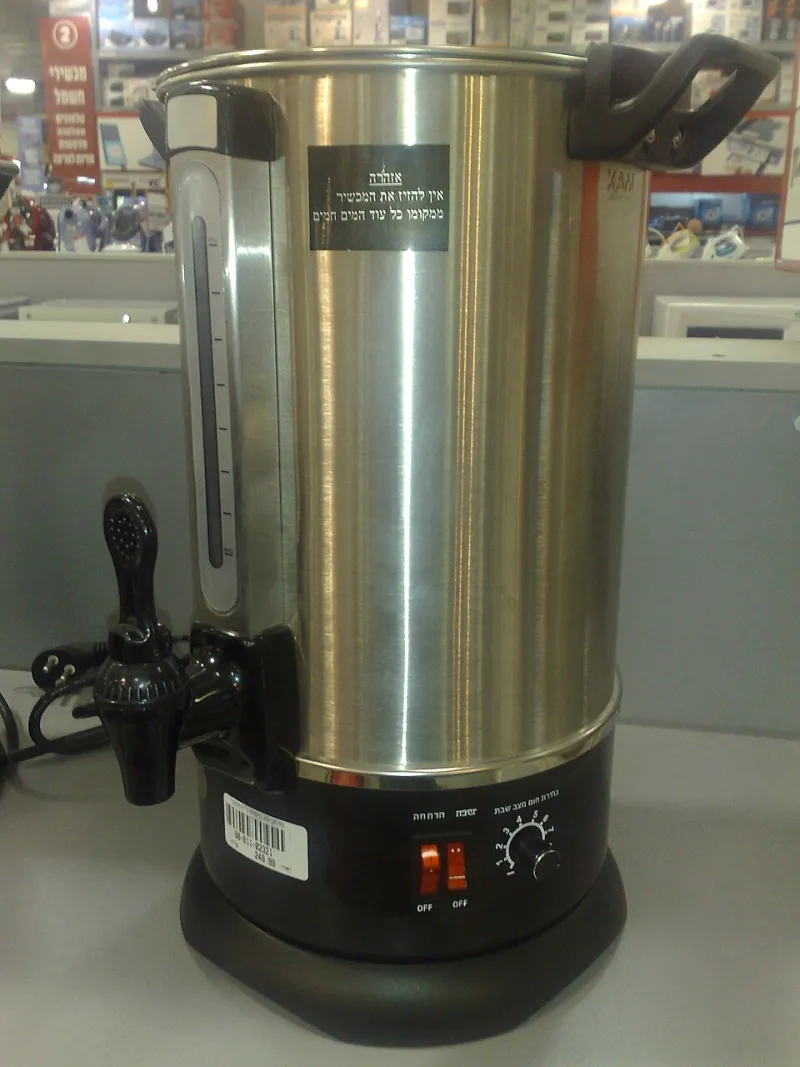
Photo: כ.אלון. Original uploader was כ.אלון at he.wikipedia, CC BY-SA 3.0, via Wikimedia Commons
Boiling-water taps have moved from novelty to routine specification in UK kitchens. They promise instant hot water for tea, pasta and sterilising jars, and they remove the kettle from the worktop. For anyone specifying natural stone or marble, however, the tap is not merely a plumbing appliance. It is a heat source, a water source and a penetration through the slab, all concentrated in one small area. The sensible question is not whether stone can survive boiling water in general, but whether the particular slab, edge detail and installation can survive the way the tap will actually be used.
Why the Tap Matters More Than the Kettle
A kettle sits on a base and radiates heat upwards and outwards. A boiling-water tap delivers near-boiling water directly downwards, often close to the sink cut-out and sometimes close to an edge or seam. That changes the pattern of exposure. The bulk of a granite or marble worktop is unlikely to be troubled by a brief run of hot water, but the local conditions matter: the cut edge of the hole, any resin-filled fissure, the sealer on the surface, and the adhesive or support beneath. These are the places where a small installation decision can become a visible problem.
It is also worth separating three issues that are often bundled together. Thermal shock is one; staining and limescale are another; mechanical damage from the tap hole is a third. A sealer may help with the second and do nothing for the first or third. A fabricator may control the third but have no influence over water hardness. A clear specification keeps those responsibilities apart.
Where Thermal Shock Actually Comes From
Thermal shock occurs when a material is subjected to a rapid temperature change that creates differential expansion and stress. In a domestic kitchen, a boiling-water tap is a repeated local heat load rather than a sudden immersion. Natural stone is generally tolerant of moderate heat, but it is not a uniform material. Veins, fissures and filled defects can behave differently from the surrounding stone. Resin fills and some sealers are more sensitive to heat than the stone itself. Marble, being softer and acid-sensitive, may show dulling or etching from other kitchen substances long before heat becomes the issue.
The greater risk is often at the edge of the tap hole. A clean, diamond-cut edge with a small chamfer or polish is more robust than a rough, chipped bore. If the hole is cut too close to an edge, a sink cut-out or a natural fissure, the stone has less material to distribute stress. The tap itself may also transfer vibration and load into the slab if it is not properly supported. In practice, thermal shock is rarely the whole story; it is usually one factor among several that were not considered at the template stage.
The Hole Is a Structural Decision
A 35 mm hole looks straightforward on a drawing. In a stone worktop, it is a fabrication operation that should be planned with the same care as the sink cut-out. The hole should be core-drilled with a diamond bit, kept wet to control dust and heat, and positioned in sound material. It should not be placed over a joint, close to a vein, or so near the front edge that the remaining stone is weakened. As a working rule, keep the tap hole well clear of any edge and follow the fabricator's minimum distances; many prefer a generous margin rather than the bare minimum.
The tap manufacturer's specification should be checked before cutting. Some boiling-water taps require a larger clearance beneath the worktop for the body of the unit, a stabiliser plate or a filter housing. Some need a specific hole diameter with little tolerance. The plumber and the fabricator should not be working from different assumptions. If the tap is supplied after the template, the position may be fixed before the installation requirements are known. That is the point at which compromises are made.
Water, Limescale and the Limits of Sealing
Boiling-water taps are often paired with filters, but filtration does not necessarily soften water. In hard-water areas, the drip and spray around the tap can leave limescale on polished stone, particularly on darker surfaces where the deposit is more visible. A sealer will slow the absorption of water and help prevent some staining, but it will not stop mineral deposits sitting on the surface. It cannot make a marble worktop immune to acid, and it cannot protect resin or stone from sustained heat. Sealing is a maintenance measure, not a force field.
The practical response is simple: specify a sealer appropriate to the stone, allow the recommended curing time before use, and accept that routine drying is part of ownership. A small drip tray or a habit of wiping the area around the spout will do more for appearance than an annual extra coat of sealer. Where water is very hard, a water softener or a suitable conditioning system is worth discussing with the installer before the tap is chosen.
Placement, Drainage and Daily Routine
Placement is about more than reaching the sink. The tap should discharge into the bowl or a dedicated draining area, not onto an unprotected section of worktop. If the spout can be swung over a stone surface, the user will eventually do so. A slight fall or a concealed drainage channel may help, but standing water should not be allowed to sit against an upstand, a seam or a cut edge. The tap hole should also be far enough from the sink cut-out to leave a sound bridge of stone, and far enough from the hob to avoid an unnecessary heat cluster.
Daily routine matters as much as specification. Emptying a boiling-water tap after use, wiping the spout area and drying the surrounding stone will reduce limescale and water marking. Avoid dragging heavy pans across the tap area, and do not use the tap body as a lever. If the tap develops a drip, have it repaired promptly; a constant trickle in one spot is more damaging than occasional splashes.
Questions to Ask Before the Fabricator Cuts
Before any hole is cut, ask who is responsible for the tap position and whether the slab has been inspected at that point. Ask what diameter and clearance the tap requires, and whether a support plate or reinforcement is needed beneath the worktop. Ask the fabricator to confirm the minimum distance from edges, seams and the sink cut-out, and to record the agreed position on the template. Ask which sealer will be applied, how long it needs to cure, and whether the tap installation affects any worktop warranty. Finally, ask what the water is like in the property and whether filtration or softening is being specified.
A boiling-water tap can sit happily in a stone kitchen for years, but only when the installation treats the worktop as part of the system rather than as a shelf with a hole in it. At Canterbury Stone & Marble, the useful conversation happens before the core drill is introduced: about the slab, the edge, the water and the way the kitchen will be used. That is the point at which a convenient upgrade remains a practical one.