Where the Bowl Meets the Stone: Specifying Sink Openings in Natural and Marble Worktops
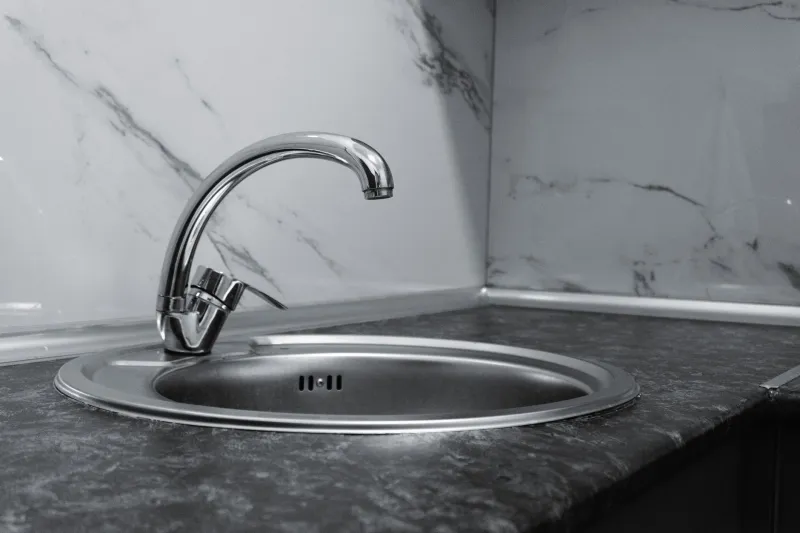
A stone worktop is usually chosen for its surface, but its weakest point is often the opening cut for the sink. That opening is not a minor detail to be agreed on site. It affects the strength of the slab, the position of taps, the way water drains and the long-term condition of the seal around the bowl. In UK kitchens, where sinks are used heavily and often sit close to dishwashers, washing machines and boiling-water taps, the specification deserves to be settled early.
Decide the sink family before the slab
The first decision is not the cut-out size but the type of sink. An undermount sink sits below the worktop, leaving the stone edge visible around the bowl. It looks clean and makes wiping down easier, but it requires a accurately cut and polished opening, reliable underside fixings and a worktop thick enough, or supported enough, to carry the arrangement. An inset sink drops into the opening with its rim resting on the stone. The cut is simpler and the rim hides the edge, but water can collect around the rim and the upstand can interrupt the line of the surface. A Belfast or butler sink is heavier and deeper, and it may sit proud of the worktop or be set with a flush detail. Each type places different demands on the carcass, the stone and the fabricator.
It is sensible to choose the sink before the stone is templated. A sink bought after the worktop has been cut may fit, but the reveal, tap positions and support may become compromises rather than decisions.
Tolerances belong at templating
A stone cut-out should be set from the sink manufacturer's template or from the physical sink itself. Approximate measurements taken from a website are not enough. The fabricator needs to allow for fixing clips, sealant, any underside brackets and the small clearance required for the sink to seat without forcing. Corners should be radiused rather than sharp; a tight internal corner concentrates stress in the stone. For an undermount sink, the reveal around the bowl is often kept to a consistent 2–3 mm, but the exact figure should be agreed with the fabricator and checked against the sink's own instructions.
Tap holes are best drilled in the workshop, not on site. The same applies to drainage grooves. These are practical machining operations that should be planned with the sink position, the tap body and the user's reach in mind.
Support the weight that is not always visible
A sink full of water is heavy, and a Belfast sink is heavier still. The stone around the opening must be supported by the cabinet, not left to span the gap on its own. Cabinet rails, corner brackets and, where necessary, a metal support frame should be specified. Undermount sinks should be held by mechanical fixings bonded or fixed to the underside of the stone, not by silicone alone. Silicone seals; it does not carry load.
This is particularly important with thinner stone sections and with large or double bowls. The cut-out should also keep a sensible distance from the front edge, from a hob and from any other opening. A worktop that looks generous in the showroom can become fragile once several openings are concentrated in one run.
Plan taps, drainage and the working surface together
Tap-hole placement is not simply a matter of centring the tap behind the bowl. The user needs room to operate the lever, and a boiling-water tap or filter tap may require additional clearance and its own hole diameter. Soap dispensers and air switches should be included in the same drawing. Confirm the required diameters with the tap manufacturer rather than assuming a standard size.
Drainage grooves can be useful beside an undermount or inset sink, but they should be shallow and properly finished. Deep grooves weaken the stone and can collect debris. Not every stone suits a grooved drainer, and some homeowners prefer a separate drainer or a carefully sloped area. The question to ask is whether the groove improves the working surface or merely adds an interruption to the finish.
Seal the opening properly and maintain it
Sealing details vary by sink type, but the principle is consistent: use a suitable neutral-cure silicone, allow the fabricator to specify the sealing method, and inspect the joint periodically. An undermount seal is largely hidden, which makes early detection of water ingress difficult. An inset rim should be sealed evenly, with no gaps behind the tap. A Belfast sink joint needs particular care because the sink is heavy and the joint is exposed.
Marble and other calcium-based stones should be cleaned with pH-neutral products. Acidic limescale removers and harsh bathroom cleaners can etch the surface and degrade sealant over time. Around a sink, where water is frequent, a little restraint in cleaning matters as much as the original installation.
Questions to settle before the stone is cut
- Which sink model has been chosen, and is the manufacturer's template available?
- Will the sink be supplied before templating so that the fabricator can measure the actual bowl?
- What reveal is intended around an undermount sink, and who confirms it?
- How will the sink be supported from below?
- Where will each tap hole, filter tap and soap dispenser be positioned?
- Are drainage grooves required, and has the stone been assessed for them?
- Who is responsible for sealing, and what sealant is specified?
- What access will be needed for future maintenance of the tap and waste?
The sink opening is a small part of the kitchen by area, but it governs much of the worktop's daily performance. Settling the bowl, the tap layout and the support before the stone is templated is the most reliable way to protect both the appearance and the practical life of a natural stone or marble worktop.